EU Battery Regulation · Article 77

Battery passport requirements, answered on one page.

From 18 February 2027 every EV, LMT and industrial battery above 2 kWh placed on the EU market needs a digital passport behind a QR code on the battery. What you build now will be sold after that date, so the label needs its code now. OrigoPass is live: generate your QR codes today and complete the data later.

On your phone? Mail this page to yourself and read it at your desk.

30 days free, no payment details · up to 1.000 QR codes free, activate them with a plan from € 59 a month

Built now, sold after 18 February 2027

The date that counts is the day a battery is placed on the EU market, not the day it was made. A pack assembled this winter and delivered in March needs a passport, and its label is printed while it is being built. So the QR code comes first, months before the data is complete.

  1. NowProduction runs

    The label is printed. It needs its QR code today.

  2. 18 February 2027The obligation starts

    For every battery placed on the EU market from that day.

  3. From then onYour stock is sold

    Each code has to open the passport of that one battery.

How that works in OrigoPass, today

  1. 1

    Reserve a batch of passport IDs

    Up to 1,000 at a time, as often as you need. Each ID is a permanent address that can be used exactly once.

  2. 2

    Download the QR codes and print

    As an Excel list or as one SVG and PNG file per code, ready for your label printer or your factory.

  3. 3

    Link code and serial number

    At the end of the line: in the console, or from the Business plan in the Excel sheet your factory fills in, or by API from your own system.

  4. 4

    Complete the passport when the data is there

    The model data once, for all its batteries. A code scanned before that says it is genuine and not yet activated: never an error page.

One decision before you print. The web address is part of the code, and a printed code keeps opening the address it was printed with. From the Business plan your codes can point at your own domain, such as dpp.yourcompany.com, instead of ours.

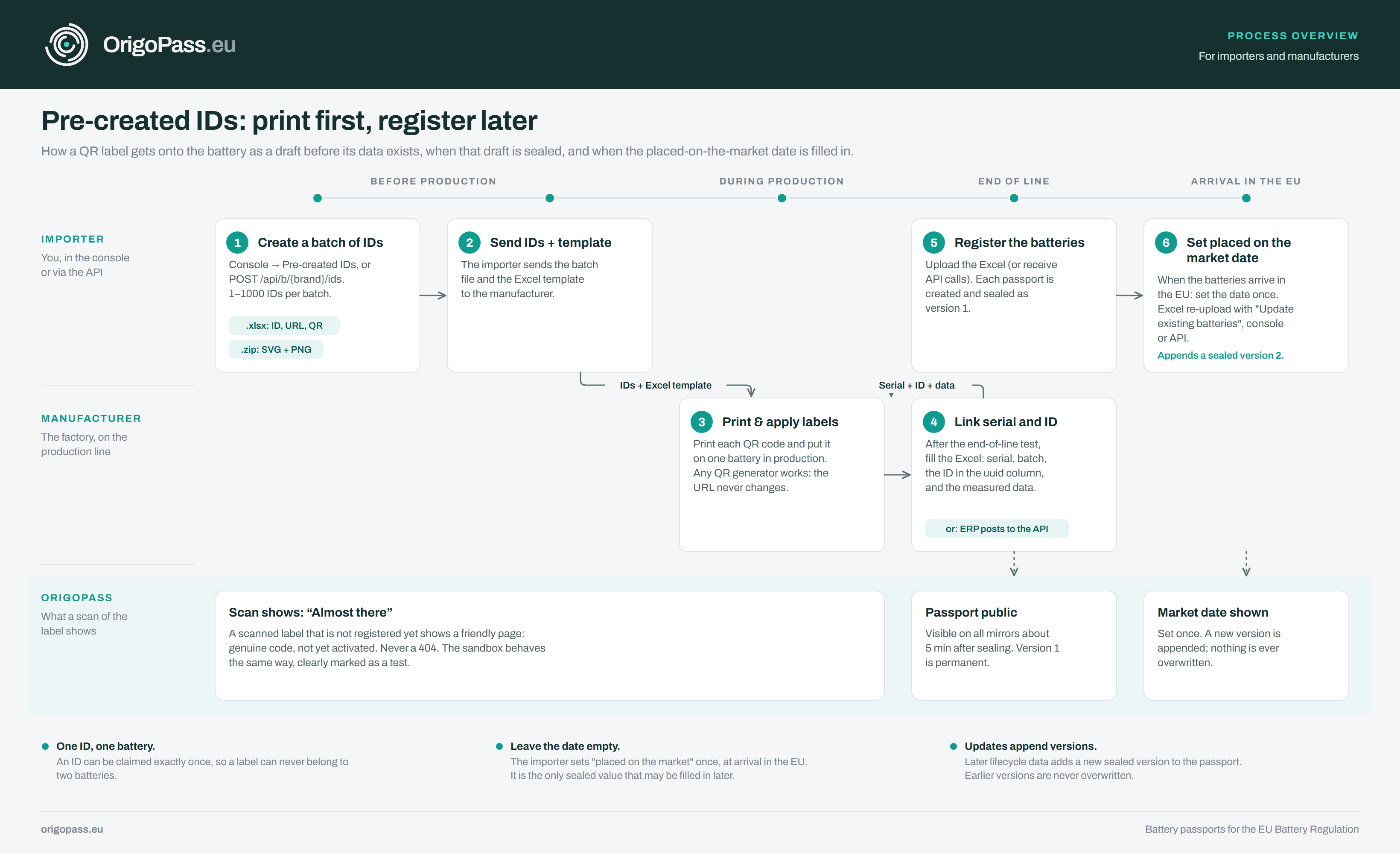
Process overview: the importer creates a batch of IDs and sends them with the Excel template; the factory prints the QR labels during production and links serial and ID at the end of the line; the importer registers the batteries and sets the placed-on-the-market date on arrival in the EU.
Who does what, and when, if a factory outside the EU prints the labels. PDF to send to your supplier

Does it apply to your battery?

Three kinds of battery need a passport. All other batteries need a QR code with their label information, but no passport.

Your batteryWhat it needsWhy
EV batteryPassportTraction batteries of electric vehicles.
LMT battery: e-bike, e-cargo bike, e-scooterPassportNo capacity threshold: every LMT battery.
Industrial battery above 2 kWhPassportHome and grid storage, forklifts, marine, machines.
Battery built into a product you importPassportThe battery is placed on the market with the product; the importer is responsible.
Repurposed or remanufactured batteryNew passportLinked to the previous one, under the new operator.
Industrial battery up to 2 kWhQR code onlyNo passport; a QR code with the label information from the same date.
Portable battery: tools, laptops, AA cellsQR code onlyNo passport; a QR code with the label information.
Starter battery (SLI)QR code onlyNo passport; a QR code with the label information.
Battery placed on the EU market before 18 February 2027Nothing newUnless it is remanufactured or repurposed after that date.
Cells or modules imported for assembly in the EUNot yetThe passport is made for the finished battery, by whoever completes it.

What has to be in the passport

56 to 62 required data points, depending on the kind of battery, in five groups. The lists below are the complete ones for the longest case; it is the same list our register checks a real passport against. The guide to the data requirements explains the fields one by one.

Identifiers and product data

Who made it and which battery it is: the manufacturer, the operator placing it on the market, model, serial number, where and when it was made.

All 11 data points
  • Manufacturer
  • Manufacturer address
  • Unique manufacturer identifier (EORI / GLN)
  • Economic operator (placing on the EU market)
  • Economic operator address
  • Economic operator identifier (EORI / GLN)
  • Battery model
  • Serial number
  • Manufacturing date
  • Manufacturing place
  • Weight (kg)

Symbols, labels and documentation of conformity

The symbols on the label and what they mean, the EU declaration of conformity and the test reports behind it.

All 6 data points
  • Labels & symbols on the battery (and their meaning)
  • EU declaration of conformity (upload)
  • EU declaration of conformity (link)
  • Test reports proving compliance (upload)
  • Test reports proving compliance (link)
  • Separate collection symbol (image)

Battery materials and composition

Chemistry, cathode, anode and electrolyte, critical raw materials, hazardous substances and the detailed composition.

All 9 data points
  • Battery chemistry
  • Critical raw materials present
  • Hazardous substances (other than Hg, Cd, Pb)
  • Usable extinguishing agent
  • Hazardous substances and their impact
  • Cathode material
  • Anode material
  • Electrolyte
  • Detailed composition

Circularity and resource efficiency

Collection and take-back, dismantling and safe removal, spare parts and the safety instructions for handling the battery as waste.

All 16 data points
  • Renewable content (%)
  • Waste prevention, collection & recycling information
  • Separate collection statement
  • Separate collection points
  • Take-back points
  • Facilities that prepare batteries for re-use
  • Facilities that prepare batteries for repurposing
  • Treatment facilities for waste batteries
  • Safety instructions for handling waste batteries
  • Impact of the substances in the battery on the environment and on health
  • Second-life / repurposing declaration
  • Dismantling & safe removal
  • Dismantling manual / exploded diagrams (PDF)
  • Part numbers of components
  • Spare parts: sources & contact details
  • Safety measures

Performance and durability

Capacity, voltage range, power capability, internal resistance, expected lifetime, efficiency and temperature range.

All 20 data points
  • Rated capacity (Ah)
  • Nominal voltage (V)
  • Minimum voltage (V)
  • Maximum voltage (V)
  • Original power capability at 80 % SoC (W)
  • Original power capability at 20 % SoC (W)
  • Maximum permitted battery power (W)
  • Initial internal resistance (mΩ)
  • Initial internal resistance of a cell (mΩ)
  • Expected cycle life (incl. test conditions)
  • Expected lifetime (cycles)
  • Expected lifetime (calendar years)
  • Capacity threshold for exhaustion (%)
  • C-rate of the cycle-life test
  • Initial round-trip efficiency (%)
  • Round-trip efficiency at 50 % of cycle life (%)
  • Operating temperature range
  • Idle-state temperature, lower limit (°C)
  • Idle-state temperature, upper limit (°C)
  • Reference test for the idle-state temperature range

Not yet required in February 2027

The carbon footprint, the recycled content figures and the due diligence report. Each starts on a date of its own; the due diligence report from August 2027. Source: the Commission's Battery Passport FAQ, September 2026.

What changes during the life of the battery

Status, state of health, cycles, remaining capacity. Updated at least when the status of the battery changes; for a new battery these fields may start empty.

Public, or only for some

Part of the passport is public, part is for authorities, part for repairers and recyclers with a legitimate interest. You grant that access per request.

Which of these do you already have? The free check holds your situation against the list and names what is missing. No account, result on screen.

The questions we are asked most

Short answers, from the Regulation and from the Commission's own guidance. Click a question to open it.

Who, and from when

Who is responsible: the manufacturer, the importer or the brand?

The economic operator that places the battery on the EU market. For a battery made in the EU that is the manufacturer; for a battery made outside the EU it is the importer. If you sell someone else's battery under your own name, you are the manufacturer for this purpose. A software supplier never takes the obligation over: a platform gives you the passport and the evidence, the responsibility stays yours.

We import complete packs from Asia. Can our supplier do the work?

The work, yes. You may give another company a written authorisation to create and update the passport for you: a non-EU manufacturer, a cell maker, a service provider. The responsibility does not move with it, and the registration in the EU registry has to be done by the operator that places the battery on the EU market. In practice: your supplier fills in the data (in OrigoPass through a personal link or an Excel sheet), you check and accept it.

Our battery is built into a machine, a vehicle or a storage system. Does it still need one?

Yes. The passport belongs to the finished battery, also when that battery sits inside another product. If you import the product with a working battery in it, you place that battery on the market. If you buy a finished battery from an EU manufacturer and only install it, the battery manufacturer is the responsible party; if you complete it yourself, for example by adding the battery management system, you are.

Cell, module, pack or system: at which level?

At the level of the finished, safely working battery. Packs that depend on one shared battery management system together form one battery with one passport; packs that each work on their own get one each. The same reasoning decides the 2 kWh threshold for industrial batteries: units that work independently are judged one by one, an integrated system by its combined capacity.

Is the date going to move?

The date is in the Regulation itself (Article 77) and it has not been changed. What is still arriving does not move it: the act on access rights and the registry's interface for software. Three things do start later, with dates of their own: the carbon footprint, the recycled content figures and the due diligence report.

What happens if we are not ready?

A battery that needs a passport and has none does not meet the Regulation, so it may not be placed on the EU market. National market surveillance authorities enforce that and can have a product corrected, held back or withdrawn. The penalties themselves are set by each Member State (Article 93), so they differ per country.

The QR code on the battery

What does the QR code have to do, and where does it go?

It goes on the battery: printed or engraved, visible, legible and indelible. Only where the size or nature of the battery makes that impossible may it go on the packaging and the accompanying documents. Scanned with an ordinary phone, without an app, it opens the passport of that one battery through its unique identifier.

Can we print the labels before the data is complete?

Yes, and for anything in production now you have to. You reserve passport IDs in advance, print their QR codes during production, and connect each code to its serial number at the end of the line. The data follows when it is ready. A code that is scanned before that shows a page saying it is genuine and not yet activated, never an error.

How long must the code keep working?

For the whole life of the battery: first use, second life, until it has been recycled. That is longer than most software contracts, so ask what happens when the contract ends. With OrigoPass every passport sealed in a paid period stays online for 15 years, also if you cancel, and you can take a signed export with you.

Do batteries without a passport need a QR code too?

Yes. From the same date every battery carries a QR code that opens its label information (Article 13): portable batteries, starter batteries and industrial batteries up to 2 kWh included. That is one page per model instead of one passport per battery.

The data

Do we need the carbon footprint by February 2027?

No. According to the Commission's Battery Passport FAQ, carbon footprint, recycled content and due diligence information are not yet required when passports start in February 2027: each has its own start date, the due diligence report from August 2027. What you do need is in the five groups above: identity, conformity, materials, circularity and performance.

One passport per model or per battery?

Per battery, by serial number. Almost all data is the same for every battery of a model, so you enter the model once. What is left per battery is a serial number, a manufacturing date and its condition as it leaves the line.

Is everything in the passport public?

No. One part is public for anyone who scans the code. One part is only for authorities and notified bodies. A third part, such as dismantling and safety details, is for parties with a legitimate interest: repairers, recyclers, second-life operators. The act that defines that last group in detail is still to come; until then you decide per request.

Does the battery have to be online, or send data from its BMS?

No. Values that change during use, such as state of health and number of cycles, must at least be updated when the status of the battery changes: when it is repurposed, remanufactured or handed in. For an e-bike battery without a connection, updating at service is considered appropriate. For a new battery those fields may start empty.

Does a repaired or second-life battery need a new passport?

A simple repair: no. A battery that is repurposed or remanufactured gets a new passport, linked to the old one, and normally a new responsible operator. That also holds for a battery first sold before February 2027 and remanufactured after it.

In which language?

Most values are numbers and codes and need no translation. Text that is not language-neutral must be in a language the users in the country of sale understand easily, as that Member State prescribes. An OrigoPass passport can carry several languages next to each other.

The registry, the technology and the cost

Do we also have to register with the EU?

Yes: the operator registers each passport in the EU Digital Product Passport Registry, under its own account, verified with a qualified electronic seal or signature. The registry is an index: it holds the identifier and the address of the passport, never the data. It has been open since 20 July 2026 and accepts battery passports, but a registration cannot be completed yet while the Commission puts its content check in place. OrigoPass produces the file the registry asks for and keeps the status per passport; you upload it under your own account.

Is a PDF or a spreadsheet behind a QR code enough?

No. The Regulation asks for a record that is machine-readable, structured and searchable, built on open standards, with different access for the public, for authorities and for repairers and recyclers, and kept up to date over the life of the battery. A static file does none of that.

Do we need blockchain?

No. No technology is prescribed. OrigoPass seals every record in an append-only, signed register that anyone can check with the public integrity check; that gives the proof without a blockchain.

What does it cost?

You pay for the new passports you seal per month; reserving codes in advance, updates and scans are not counted. Starter: € 59 a month for 100 new passports. Business: € 149 a month for 500 new passports. Scale: € 349 a month for 2.500 new passports. No setup fee, about 15% off when paid yearly. All plans and what is in them.

How long does it take?

The software is the short part: an account in minutes and, on a paid plan, a batch of QR codes the same hour. The data is the long part. Composition, test reports and dismantling information usually come from whoever built the pack or the cells, and the first request is rarely the one that gets an answer. That is the reason to start the data now and not in February.

Can we try it first?

Yes: 30 days free with one product, one passport and one QR code, every feature unlocked, no payment details. What you make in the trial stays valid when you subscribe.

Sources: Regulation (EU) 2023/1542, Articles 13, 77 and 78 and Annex XIII; EU Digital Product Passport FAQ for Batteries, 1st edition, September 2026. This page is general information, not legal advice; the responsibility for compliance rests with the operator placing the battery on the market.

More background in our guides: the EU battery passport in 2027, the Annex XIII field list and the QR code on the label.

Live now, not in development

Everything on this page works today. You can check that yourself before you talk to anyone.

Open a real passport

The page a customer, a repairer or an inspector sees after scanning the code, with every data group filled in.

Tested against the EU registry

OrigoPass is enrolled and verified in the EU Digital Product Passport Registry as an economic operator and has submitted passports to it.

Your production is running. Your codes can be too.

Start free with one passport and one QR code, or take a plan and reserve the codes for your next production run today.

Not ready to start?

Leave your address and get one mail when the rules change: a new act, a new date, guidance from the Commission. Nothing else.

You confirm from your mailbox. Unsubscribe with one click. What we keep